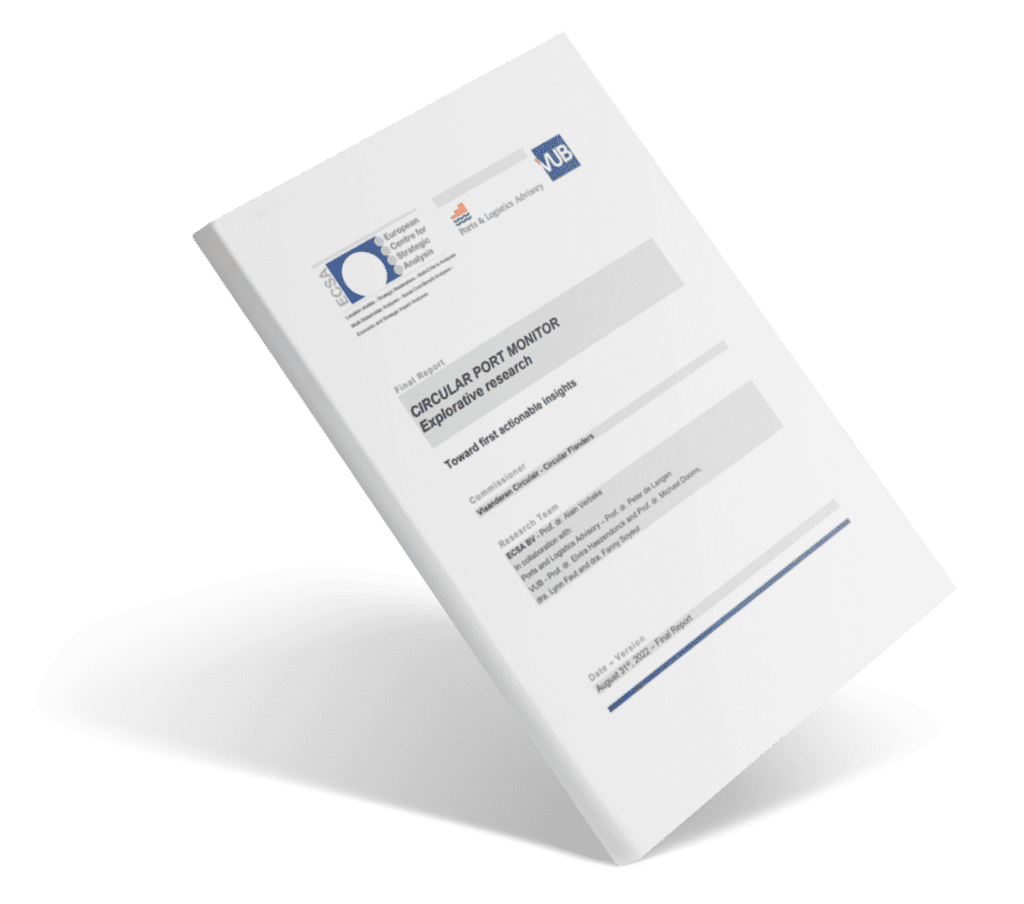
Circular Flanders’ CE Centre launched the Circular Economy Monitor Flanders, featuring 100+ indicators to measure the maturity of the circular economy in Flanders and the speed at which it is progressing. A complementary Circular Ports Monitor was developed in 2021, with 12 indicators tailored to the port ecosystem. While globally applicable, some indicators may suit specific port types. The tool enables ports to benchmark internationally and monitor their own progress.

Twelve indicators for circularity in ports
Discover the set of 12 indicators based on information that is relatively easy to obtain and meaningful to share. The indicators have been selected to be relevant in the context of the circular economy objectives for ports.
The role of PMBs as cluster managers has been highlighted, but proper monitoring of the circular transition in ports is a shared responsibility. By supporting PMBs and port companies with tools, insights and a certain level of data commitment, they will be able to take up this necessary challenge.
There is no hierarchy of importance suggested by the placement order. The relevance of each indicator depends on the specific context of each port. The measurements for these indicators are mostly expressed in shares, rather than absolute numbers. The aim is to monitor evolution over time within a port; and allow for benchmarking between ports.
Click on each indicator below to learn more about its definition and methodology.
Research behind the Circular Port Monitor
In 2021, Circular Flanders launched an exploratory study on CE monitoring in Ports, resulting in a conceptual framework and a longlist of indicators. After expert review, 12 indicators were selected and tested in a real port setting.
In 2024, the two year Research Chair on Circular Port Monitoring was established at VUB, funded by Circular Flanders and three Flemish seaports: Port of Antwerp Bruges, North Sea Port and Port Oostende. This research focuses on developing a system to measure the socio-economic impact of circular transitions in ports, aligned with sustainability reporting and strategic planning The 12 indicators of the monitor will be tested in the field by the Flemish seaports. Prof. Dr. Elvira Haezendonck leads the chair, with Dra. Lynn Faut as coordinator.
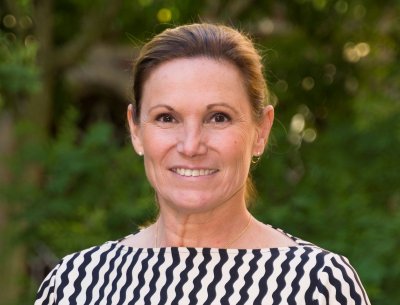
Prof. dr. Elvira Haezendonck (Vrije Universiteit Brussel and Solvay Business School) is Full Professor at the Vrije Universiteit Brussel (VUB) and Visiting Professor at the University of Antwerp (UA), as well as guest lecturer at Erasmus University of Rotterdam (Maritime Economics and Logistics). Her research covers topics in the field of sustainable strategies and management, applied to infrastructure, ports and complex projects.
She has published various articles, books and book chapters in relation to sustainable strategies, project evaluation, competitive analysis and stakeholder management, and since 1996, she has been involved in over 100 national and EU research projects on for example strategic analyses and impact assessments in/for ports and infrastructure, and on complex project management. She teaches several strategy and (project) management courses on both bachelor and master level.
She also takes up multiple board positions within and beyond academia. In 2022 Prof. dr. Elvira Haezendonck was elected as first female president of the International Association of Maritime Economists (IAME), the global academic association of maritime economists. Since 2010 she has (co-)promoted two consecutive Research Chairs on Public-Private Partnerships at VUB, and currently she is in the lead of a third research chair on Infrastructure Asset Management, sponsored by Antea, Arcadis, Sweco and Tractebel.
Contact: elvira.haezendonck@vub.be
Elvira Haezendonck
Professor
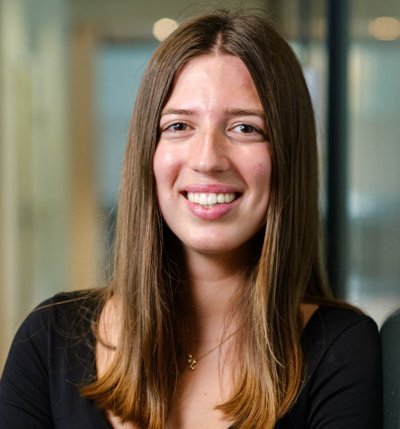
Lynn Faut is a doctoral candidate at the Free University of Brussels (VUB). She studied Business Engineering at Solvay Business School where she graduated summa cum laude and received the 2021 Excellence Award. Since then, she joined the Management and Strategy Team at VUB as a PhD candidate where she researches circular economy monitoring in ports.
Lynn has always been passionate about the circular economy and tries to integrate it into her daily lifestyle.
Contact: lynn.faut@vub.be
Lynn Faut
PhD Researcher
Chair Partners ‘Circular Port Monitoring in Flanders’



Recommended Reads

PORTOPIA project
The PORTOPIA project, which started in 2013, aimed at the development of key performance data for European ports and the…
Read more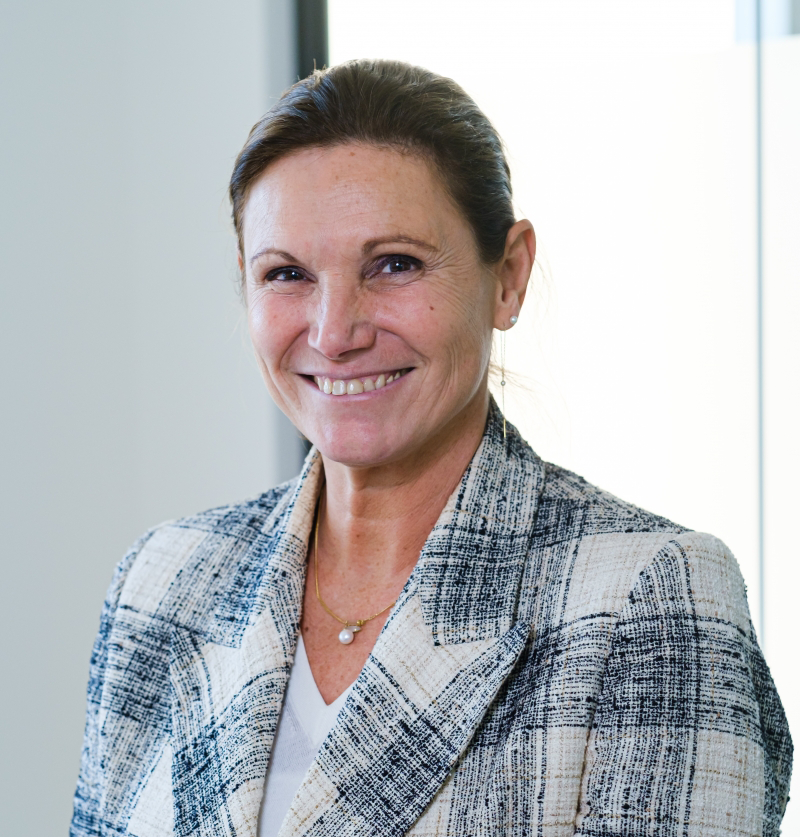
Interview with Prof. Haezendock on the Circular Port Monitor
Interview with Professor Elvira Haezendonck (VUB) on the Circular Port Monitor.
Read more
ESPO Environmental Report 2022
After 25 years of the EcoPorts Network, ESPO presents the 7th Annual Environmental Report.
Read more