

Indicator
Circular Business activities are defined as revenue generating activities, that contribute to the circular economy. This contribution can achieved through one, or multiple R-strategies.
- Core CE business activities contribute ≥ 70% of the total business revenue.
- Peripheral CE business activities contribute < 70%.
This indicator is relative (share), reflecting the number of circular business activities compared to the total number of business activities in the port area. The port area is defined as the geographical territory managed by the Port Management Body (PMB).
How to measure its value
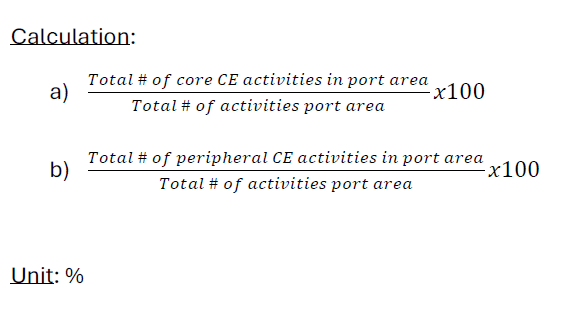
The core circular business activities can be identified by the relevant NACE-codes (Bel-first, GraydonCreditsafe database and PMB database), linked to the R-strategies. Additionally, the PMB can be asked to check for missing or wrong data.
The peripheral CE activities and total number of activities are to be collected from the PMBs databases.
Selected NACE-codes:
- Repair (33.110-33.190, 95.110-95.120, 95.210-95.290)
- Renting and leasing (77.200-77.299, 77.300-77.399)
- Waste Management and Material Recovery (37.000, 38.110-38.120, 38.211-38.222, 38.310-38.329, 46.771-46.779)
- Maintenance of motor vehicles (45.201-45.209, 45.310-45.320, 45.401-45.402)
- Second-hand sales (47.791-47.793)
- Building restoration (43.995)
Limitations
- Currently, the hierarchy of R-strategies and the extent of their impact are not taken into account. Nor is the percentage of revenue generated by the circular activities for peripheral activities.
- The limitation of the measurement to the geographical boundary of the managed port area allows for feasibility of correct data collection. However, it excludes circular business activities in the vicinity that might have links to the port cluster.
- Internal circular activities or waste management systems are not taken into account, as they do not generate revenue.
- The NACE-code classification is not fine-grained enough to capture all circular activities. Furthermore NACE-codes may be incorrect due to self-reporting and limitation to a single code per company. Therefore it is important to combine this selection with information from the PMBs.
- It can be challenging to identify peripheral CE activities, which might lead to an underestimation.
- PMBs might not have the required data readily available for the baseline measurement. This would require some extra work for the first measurement, that should pay off for the future measurements.