Indicator
This indicator is relative, expressed as a share comparing the number of jobs linked to core circular business activities to the total number of jobs in the port area.
Circular Business activities generate revenue and contribute to the circular economy through one, or more R-strategies. Core circular business activities contribute ≥ 70% to the total business revenue. The port area is defined as the geographical territory managed by the Port Management Body.
How to measure its value
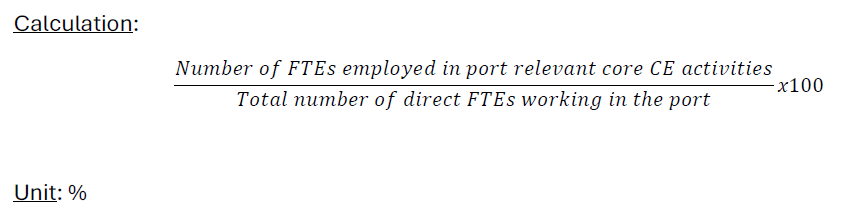
- For this indicator, employment is defined as the number of officially registered full-time equivalents (FTEs). No distinction is made between employment in which the employee carries out a circular activity (e.g. an operator) and one where the employee handles supporting or overhead tasks such as a recycling plant’s accountant. The total number of full-time employees working in the circular firm’s facility counts towards the indicator.
- List of Core CE firms: Bel-first database and PMBs (see Indicator 1: Share of port-relevant CE business activities located in the port area).
- Number of FTEs in circular activities: Bel-first database, GraydonCreditsafe database, CompanyWeb, PMBs, individual circular activity firms.
- Total direct FTEs for each port: Report on the Economic importance of the Belgian maritime and inland ports (National Bank of Belgium) and the Dutch Port Monitor.
Limitatons
- It is not always feasible to allocate correct FTE-data if a company has multiple branches that are not all located in the port area.
- Consultants, freelancers, students, interns and temporary workers are not included in the FTE-data.
- The indicator does not take into account employment linked to peripheral CE activities or CE projects.
- It is advisable to take into account the port-size and number of companies present when comparing between ports.