Abstract
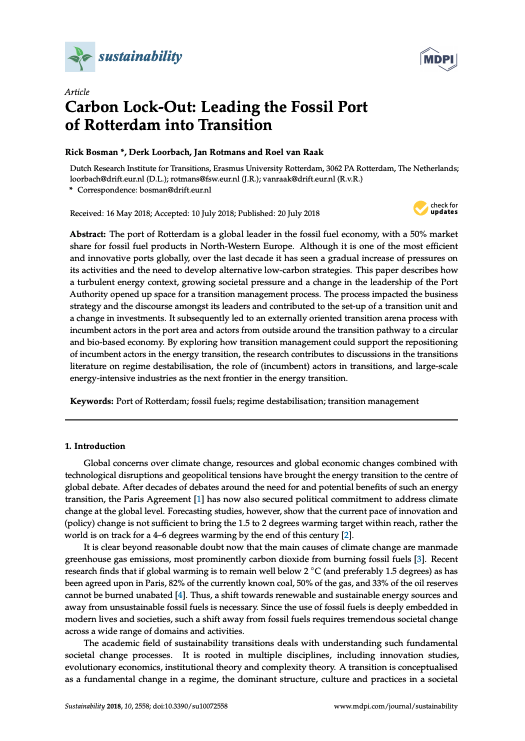
The port of Rotterdam is a global leader in the fossil fuel economy, with a 50% market share for fossil fuel products in North-Western Europe. Although it is one of the most efficient and innovative ports globally, over the last decade it has seen a gradual increase of pressures on its activities and the need to develop alternative low-carbon strategies. This paper describes how a turbulent energy context, growing societal pressure and a change in the leadership of the Port Authority opened up space for a transition management process. The process impacted the business strategy and the discourse amongst its leaders and contributed to the set-up of a transition unit and a change in investments. It subsequently led to an externally oriented transition arena process with incumbent actors in the port area and actors from outside around the transition pathway to a circular and bio-based economy. By exploring how transition management could support the repositioning of incumbent actors in the energy transition, the research contributes to discussions in the transitions literature on regime destabilisation, the role of (incumbent) actors in transitions, and large-scale energy-intensive industries as the next frontier in the energy transition.