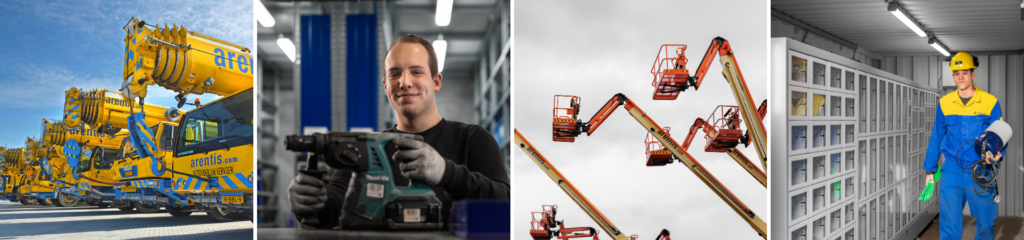
In the industrial environment of North Sea Port Ghent, access to the right equipment is essential for maintenance, construction and other specialised operations. ARENTIS provides companies with access to industrial machinery and tools through a rental-based business model.
Rather than requiring every company to own equipment that may only be needed periodically, rental allows machinery and tools to be used by different customers over time. In circular-economy terms, this represents a shift from ownership towards access and shared use, potentially increasing the utilisation of each asset and reducing the need for companies to maintain their own stock of infrequently used machinery.
Making better use of industrial assets
The ARENTIS rental portfolio ranges from relatively simple hand and lifting tools to specialist machinery and industrial equipment. Its catalogue includes, for example, hydraulic equipment, lifting devices and electrically powered machinery.
This model is particularly relevant in a large industrial cluster. North Sea Port is home to more than 550 companies, creating a concentration of industrial users with changing and often temporary equipment needs.
By circulating equipment between users and applications, a rental model has the potential to deliver more productive use from each machine over its operational lifetime. It can also give industrial companies access to specialised equipment without each individual business having to purchase and hold the same assets.
Circularity as a service
The circular value of ARENTIS therefore lies first and foremost in its service model. Rental can decouple the use of equipment from individual ownership. The value provided to the customer is not the machine itself, but the function it delivers for the duration of a project.
For an industrial port, this approach is significant. Maintenance works, construction projects and other temporary activities can generate peaks in demand for specific machinery. A shared equipment pool can respond to these needs while avoiding a situation in which similar machines are purchased by multiple companies but remain idle for significant periods.
The model is a practical example of one of the strategies associated with a circular economy: intensifying product use through sharing and product-as-a-service models. Its actual environmental impact depends on factors such as utilisation rates, equipment lifetime, maintenance, logistics and what happens to machines at the end of their useful life.
Supporting a more circular industrial ecosystem
The location of ARENTIS is particularly interesting in the wider transition of North Sea Port Ghent. North Sea Port is developing the 150-hectare North-C Circular industrial site in Ghent together with ArcelorMittal and the Flemish Government. The development is intended to attract activities focused on circularity, CO₂ reduction and the energy transition, and forms part of the port’s ambition to become climate-neutral.
Within such an industrial ecosystem, circularity is not only about transforming waste into secondary raw materials. The way industrial assets are used matters too. By allowing machinery and tools to serve multiple companies and projects, ARENTIS illustrates how service-based business models can complement material recycling and industrial symbiosis.
Its Ghent operation therefore provides a straightforward example of circularity at the level of industrial equipment: use rather than ownership, shared rather than individual assets, and extracting more value from equipment already in circulation.
Source and image credit: Arentis